
IBM Design Challenge
EMT Assist: Decision Aid for Emergency Medical Technician
Team - Kanupriya Yadav (Individual)
Tools - Figma
Timeline - 2 days
EMT Assist is a platform designed to provide assistance or decision support to emergency medical technicians (EMTs). The app offers a range of tools and resources to help EMTs in their work, such as location finding, protocols and guidelines for managing various medical emergencies, access to drug information and clinical decision support tools, or real-time traffic updates and routing information.
The app is intended to be a helpful resource for EMTs, helping them to make informed decisions and provide the best possible care to patients.
Problem
The lack of clear duties and responsibilities, insufficient EMT authority, inadequate EMT competencies, and a lack of appropriate on-scene decision-making protocols and guidelines all contribute to fear and concern when making decisions in the pre-hospital setting.
"How might we help EMTs make better decisions and deliver the best possible pre-hospital care to patients by using technology and data-driven solutions?"
"How might we enable EMTs to make informed decisions and provide the best possible care to patients?"
Goals
-
To provide EMTs with access to protocols and guidelines for managing various medical emergencies and conditions.
-
To help EMTs quickly assess a patient's condition and determine the appropriate course of treatment.
-
To provide EMTs with access to drug information and clinical decision support tools to help inform their treatment decisions.
-
To help EMTs navigate to the scene of an emergency as quickly as possible by providing real-time traffic updates and routing information.
-
To help EMTs stay up to date on the latest best practices and evidence-based medicine by providing access to clinical practice guidelines and other resources.
-
To improve the overall efficiency and effectiveness of pre-hospital care by enabling EMTs to make more informed decisions and provide the best possible care to patients.
Research and Process
Understanding the Emergency Medical Technician
An EMT provides transportation and emergency on-site medical care for seriously injured or unwell patients who need quick medical attention. EMTs provide this fundamental and urgent medical care inside an ambulance using the equipment and supplies that are there while making sure that every second counts.
Stabilizing a patient and transporting them safely to a medical facility where they can receive additional care is the aim of an EMT. However, EMTs often work in pairs or teams with other EMTs rather than alone to ensure they deliver the best care possible.
Duties and Responsibilities
-
Provide basic first-aid treatment as needed
-
Respond appropriately to emergency calls
-
Assess a person’s condition and know how to provide proper medical care
-
Put together an initial plan of care to quickly stabilize an individual in distress
-
Provide life-saving medical interventions like CPR
-
Determine where to transport a patient for continuing care
-
Communicate clearly and effectively with other first responders and emergency medical staff, and personnel
-
Maintain 12-hour shift schedules and on-call hours
-
Document medical care given to patients
-
Report patient observations to appropriate medical professionals.
Problems faced by the EMTs
-
Time constraints: EMTs may face time constraints in terms of responding to an emergency in a timely manner, providing treatment and transportation to the patient, and completing documentation and other administrative tasks.
-
Limited resources: EMTs may face limited resources in terms of equipment, supplies, and personnel, which can impact their ability to provide the necessary care to the patient.
-
Indecision or uncertainty: EMTs often face situations where they must make decisions in complex and rapidly changing environments, often with limited information and under time pressure. This can lead to uncertainty about the best course of action, which can be stressful and challenging for EMTs.
-
Communication challenges: EMTs may face communication challenges in terms of communicating with the patient, their family, and other healthcare providers. This can be particularly challenging in emergency situations where time is of the essence.
-
Physical demands: EMTs face physical demands in terms of lifting and moving patients, as well as working in potentially hazardous environments.
-
Legal and ethical issues: EMTs may face legal and ethical issues in terms of making decisions about the care and treatment of patients, as well as navigating HIPAA regulations and other legal considerations.
Focusing on a Problem Area
“Decision making in the context of fear and concern”
-
To manage life-threatening conditions and reduce morbidity and mortality, pre-hospital’s on-scene decision making is an influential factor.
-
Triage is used to make decisions about the type and priority of emergency medical interventions. Because some patients' conditions are complex and variable, technicians' decisions change frequently, which can lead to technician error. Decision-making errors endanger patients' safety.
-
Proper emergency medical decision-making prevents hospital emergency unit overcrowding, improves health-care quality, and, ultimately, reduces morbidity and mortality.
Scoop and Run Approach
Scoop and run literally translates as 'charge and run'.
These terms refer to getting a patient to a hospital facility as soon as possible so that he or she can benefit from hospital care.
The key concept is thus to avoid delaying the patient's transport.
If at all possible, care will not be initiated on the spot.
Stay and Play Approach
Care takes precedence over transportation in this approach
The patient cannot be transported without first being stabilized.
Starting treatment as soon as possible, even if it is only temporary, can limit shock and increase the patient's chances of survival and autonomy by reducing the number of compensatory systems the patient needs to employ.
Main Insight
EMTs are often unaware of their responsibilities, having multiple and sometimes indefinite responsibilities not only leads to neglect of necessary interventions, but also to excessive stress and anxiety.
User Persona

User Journey
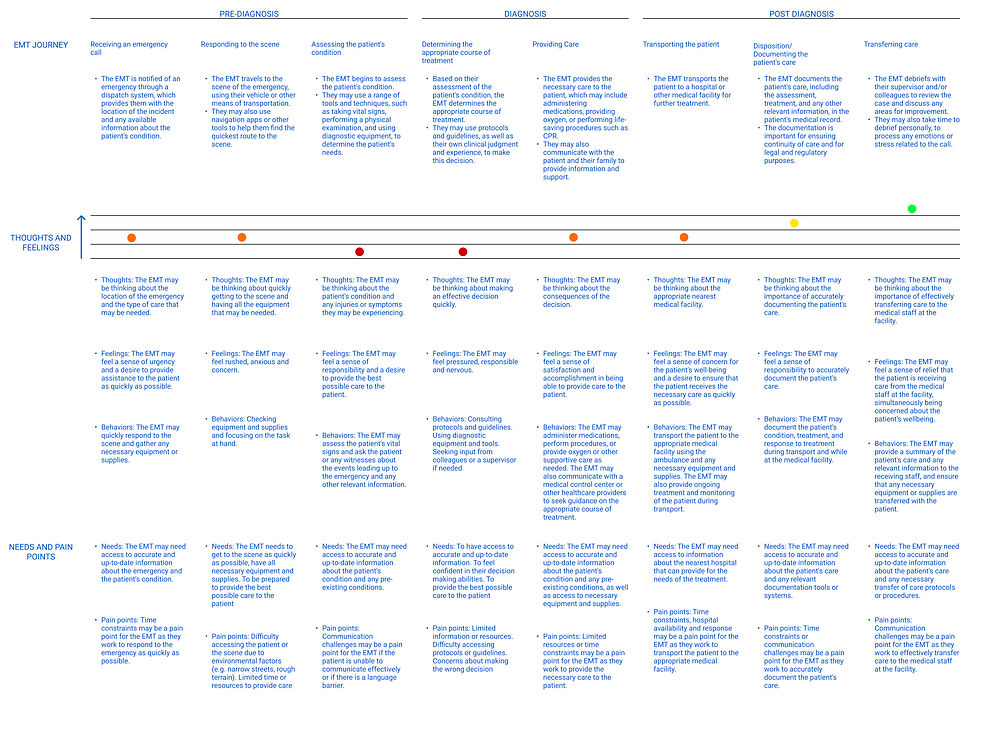
Ideation

Solution
Feature Set
Low Fidelity Prototypes
EMT Assist is a decision support tool designed for EMTs, providing them with the information and resources they need to make informed decisions and provide the best possible care to their patients.

Onboarding with Decision Support:
EMT Assist helps the EMT to easily find the best suited hospital by analyzing the patient conditions/ symptoms and injuries sustained.

Availability Confirmation:
The EMT send an alert to the appropriate nearest hospitals, hospitals send an availability confirmation post which the patient is transported to the receiving hospital.

Dashboard:
The dashboard displays all the critical information- Tracking patient vitals and raising concerns, patient medical history (assumption of compulsory patient medical records), allergies and any ongoing medication/ treatment to help EMTs make informed decisions about patient care.
Information on receiving hospital, point of contact and appointed doctor.
Alerts

Safety Alert:
The dashboard includes safety alerts and warnings, such as notifications about hazardous conditions or potential dangers, can help EMTs and receiving hospital stay safe while on the job.
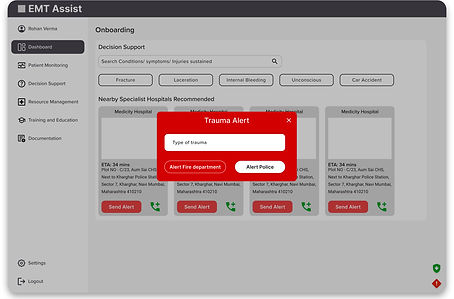
Trauma Alert:
In the case of a trauma emergency, the dashboard allows EMTs to quickly alert the police and other emergency services (fire department).

Patient Monitor:
Real-time patient data acquired in the ambulance can be extremely valuable for EMTs in making better decisions and delivering better care. This type of data can include vital signs, such as heart rate, blood pressure, and respiratory rate, as well as other information such as oxygen saturation levels, electrocardiogram (ECG) readings, and blood glucose levels.
Decision Support:
The dashboard provides EMTs with real-time guidance on how to treat the patient based on their condition and any pre-existing conditions.
The dashboard also supports remote video consulting with the appointed doctor/ various specialists to assist EMT in extreme conditions.
The dashboard is also equipped with clinical guidelines, protocols/ algorithms that can be easily accessible by searching for patient conditions/ symptoms and injuries.


Training and Education:
The dashboard includes access to training materials and other educational resources can help EMTs stay up-to-date on the latest techniques and protocols for patient care.

Resource Management:
The dashboard helps EMTs manage resources, such as equipment and supplies, can help them ensure they have everything they need to provide care to patients.

Documentation:
The dashboard allows EMTs to document the patient's care and treatment during transport. This could include taking photos, recording notes, and generating reports that can be shared with the receiving hospital to save time.
Impact
EMT Assist can potentially have a significant impact on saving lives by providing EMTs with access to guidelines and protocols for a variety of medical emergencies. This can help EMTs make informed decisions about how to care for patients and ensure that they receive the appropriate level of care in a timely manner.
EMT Assist dashboard can also help EMS organizations track trends and identify areas for improvement.
Reflection
I learned
The importance of defining the problem: It is important to start with a clear understanding of the problem or need that the app is intended to address. At the initial stage, I had several ideas on creating an app with numerous features but it was critical for me to identify the core problem and work towards solving it.
Challenges of designing for high-stress situations: EMTs may face high levels of stress when responding to medical emergencies, which can affect how they use the app. It's important to consider this when designing the app and ensure that it is intuitive and easy to use in high-stress situations.
I would change
Currently, the project was on a really tight deadline with secondary research as the basis of the project, I would like to validate my research and process by conducting primary interviews with the end users, conduct usability testing of the low fidelity prototypes, consider insights and take the project further.

